
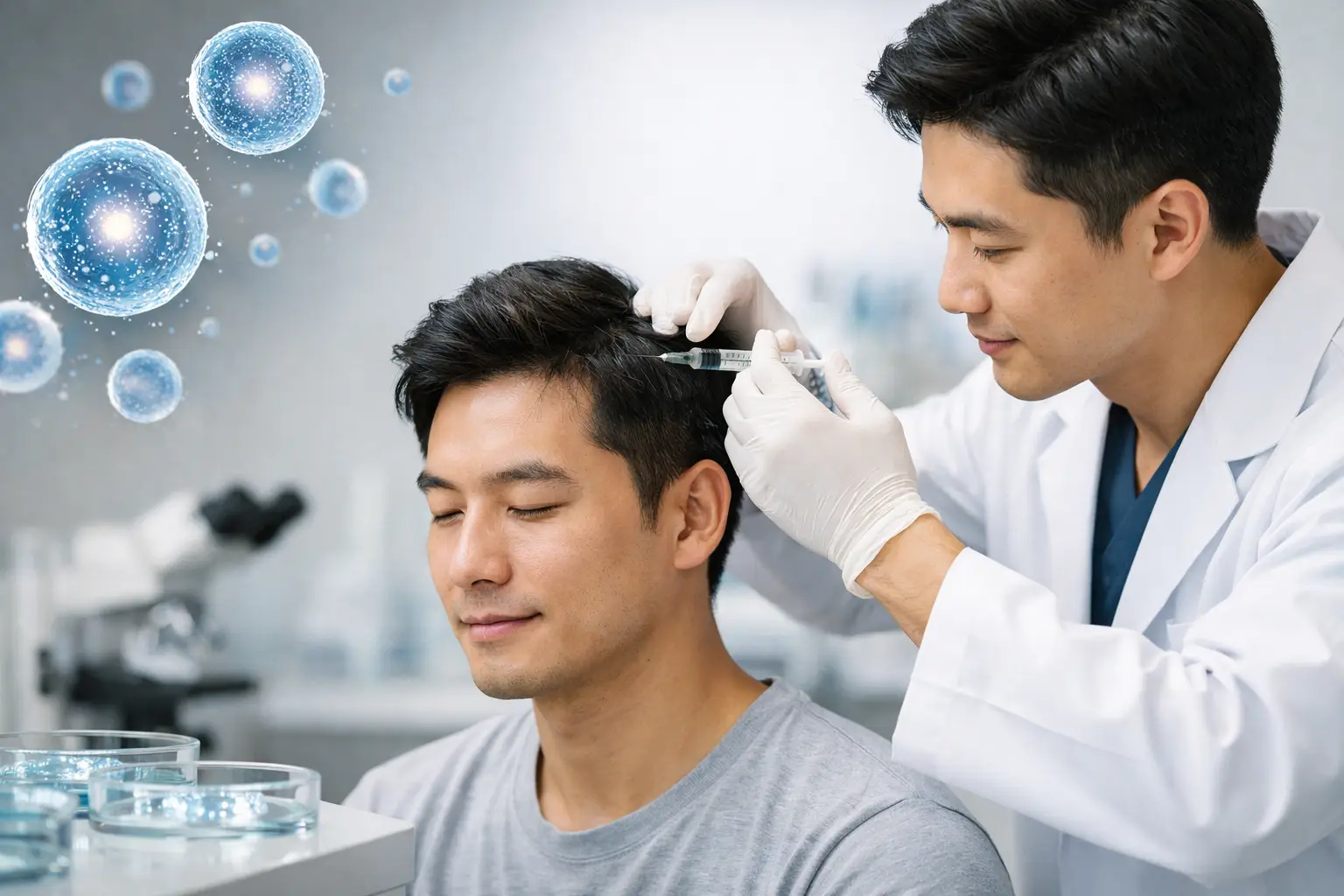
Hair thinning rarely starts all at once. More often, it shows up in the mirror under bright light, in photos from the wrong angle, or in the extra time you spend styling your hair to cover areas that used to look full. That is why interest in exosomes for scalp rejuvenation has grown so quickly. Men are not just looking for hair loss treatment. They want options that support a healthier scalp environment and fit into a plan that feels modern, medically guided, and discreet.
What exosomes for scalp rejuvenation actually means
Exosomes are tiny particles released by cells. They carry signaling molecules such as proteins, lipids, and growth-related factors that help cells communicate with one another. In scalp treatment, the goal is not to transplant hair or force instant regrowth. The goal is to improve the local environment around hair follicles so the scalp is better positioned to support healthier hair activity.
That distinction matters. When men hear about newer regenerative treatments, they often assume the promise is simple: get injections, grow hair. Real medicine is more nuanced than that. Hair loss can involve genetics, age, hormone sensitivity, inflammation, stress, scalp condition, and overall health. Exosome-based therapy is usually discussed as a supportive treatment, not a magic fix.
In practical terms, exosomes for scalp rejuvenation are typically used as part of a broader strategy for men with thinning hair, early pattern hair loss, or a scalp that appears less healthy over time. A physician may recommend it to support follicle function, improve scalp quality, or complement other treatments already in progress.
Why the scalp matters as much as the hair
Many men focus only on the strands they can see. Clinically, the scalp deserves just as much attention. Hair follicles depend on a stable local environment – one with good circulation, controlled inflammation, and healthy tissue signaling. If that environment is poor, even a strong follicle can gradually become less productive.
This is one reason scalp rejuvenation has become an important concept in aesthetic and hair medicine. Instead of asking only, “How do we grow more hair?” physicians also ask, “How do we improve the condition of the scalp that supports the hair?” Exosomes are part of that conversation because they are being studied for their potential role in tissue repair and cellular communication.
For the right patient, this approach may be appealing. It is especially relevant for men who are seeing mild to moderate thinning and want to act before hair loss becomes more advanced. Earlier treatment often gives more options.
How treatment is usually approached
The exact protocol varies by clinic and medical assessment, but treatment generally starts with consultation. This is where a physician looks at the pattern of hair loss, the scalp condition, medical history, and current medications or treatments. That step is essential because not every form of shedding or thinning should be treated the same way.
Once a patient is considered suitable, the scalp is prepared and the exosome product is delivered to targeted areas, often through microinjections or with techniques designed to enhance scalp absorption. The session itself is usually straightforward and done in an outpatient setting.
Most men want to know two things right away: how uncomfortable it is and how long it takes. Discomfort is usually manageable, and sessions are relatively short. There may be temporary redness or sensitivity afterward, but downtime is generally limited. Still, “minimal downtime” does not mean “no aftercare.” Patients should follow their doctor’s instructions closely, especially around washing the scalp, exercise, and using topical products immediately after treatment.
What kind of results are realistic
This is where expectations need to stay grounded. Exosomes are not the same as a hair transplant, and they do not recreate follicles that are no longer viable. They may help support existing follicles and improve scalp quality, but results depend heavily on the stage and cause of hair loss.
Men with early thinning may notice reduced shedding, improvement in scalp condition, or hair that appears stronger over time. Some also report that hair looks denser or healthier in treated areas. These changes usually develop gradually, not overnight.
Men with advanced baldness may still be interested in scalp rejuvenation, but expectations have to be different. If follicles have been inactive for a long time, regenerative support alone may not be enough. In those cases, exosomes may be considered an adjunct rather than a primary solution.
A credible clinic should be upfront about this. Promising dramatic regrowth for every patient is not a sign of innovation. It is a sign of poor medical judgment.
Who may be a good candidate for exosomes for scalp rejuvenation
The best candidates are often men who notice early pattern thinning, reduced hair density, increased shedding, or a scalp that seems less healthy than before. It may also appeal to men who want a physician-led option that can be integrated with a broader hair restoration plan.
Suitability depends on several factors, including the degree of miniaturization in the follicles, whether active scalp disease is present, and whether underlying issues such as hormonal imbalance or nutritional concerns have been considered. A proper evaluation matters because thinning hair is a symptom, not a diagnosis.
That is particularly important for men who are already dealing with fatigue, changes in body composition, or other age-related shifts. Sometimes hair changes occur alongside broader health concerns. In a medical setting, those patterns can be assessed more thoroughly rather than treated as cosmetic issues alone.
Exosomes versus other hair loss treatments
Men often compare exosomes with PRP, medications, or transplant surgery. That comparison is reasonable, but the answer is rarely either-or.
PRP uses the patient’s own blood components and is intended to support healing and follicle activity through growth factors released from platelets. Exosomes are different in origin and mechanism, and some patients are drawn to them because of the signaling role they may play in tissue communication. Whether one is better than the other depends on the clinical goal, the product used, and the physician’s treatment philosophy.
Medications remain relevant because they target specific drivers of hair loss, especially androgen-related thinning. For some men, medication forms the foundation of treatment while procedures such as exosome therapy are used to enhance results. For others, the best plan may be conservative monitoring plus scalp support.
Hair transplant surgery addresses loss in a different way by relocating follicles. It can be highly effective in selected patients, but it is not the first step for everyone. Men in earlier stages of thinning may prefer to try non-surgical options first, especially if the goal is to preserve and strengthen what they still have.
Questions worth asking before treatment
Not all exosome treatments are equal, and not all providers approach them with the same level of clinical rigor. Before proceeding, a patient should understand what product is being used, how it is administered, what evidence supports the approach, and what outcome is realistically expected in his case.
It is also reasonable to ask whether the treatment is being recommended as a standalone option or as part of a larger plan. That answer tells you a lot. Hair restoration is usually more effective when it is individualized rather than sold as a one-size-fits-all package.
A good consultation should also cover timeline. Men often underestimate how long hair responds to treatment. Even when the scalp environment improves, visible hair changes take time because follicles cycle slowly. Patience is not just helpful here. It is part of the treatment process.
Why physician guidance matters
Because hair loss affects confidence, many men are vulnerable to overpromising marketing. Terms like regenerative, advanced, and next-generation can sound persuasive, but they do not replace diagnosis, medical screening, or honest case selection.
Physician oversight matters for three reasons. First, the cause of hair loss needs to be identified as accurately as possible. Second, treatment suitability must be assessed in the context of your health, not just your appearance. Third, follow-up matters. Hair and scalp treatments often work best when response is reviewed, adjusted, and combined with other appropriate care.
At a clinic such as Catalyst Clinic, that medical approach can make the process feel more straightforward. Men who value privacy often do better when they can discuss hair concerns in the same setting that handles broader wellness, hormonal evaluation, and age-related health changes with discretion.
Exosomes for scalp rejuvenation are promising because they reflect a broader shift in medicine – away from simplistic fixes and toward improving the conditions that help tissue perform better. For men noticing early changes in hair density or scalp quality, that can be a smart time to seek proper assessment. The sooner the conversation starts, the more options you usually have.