
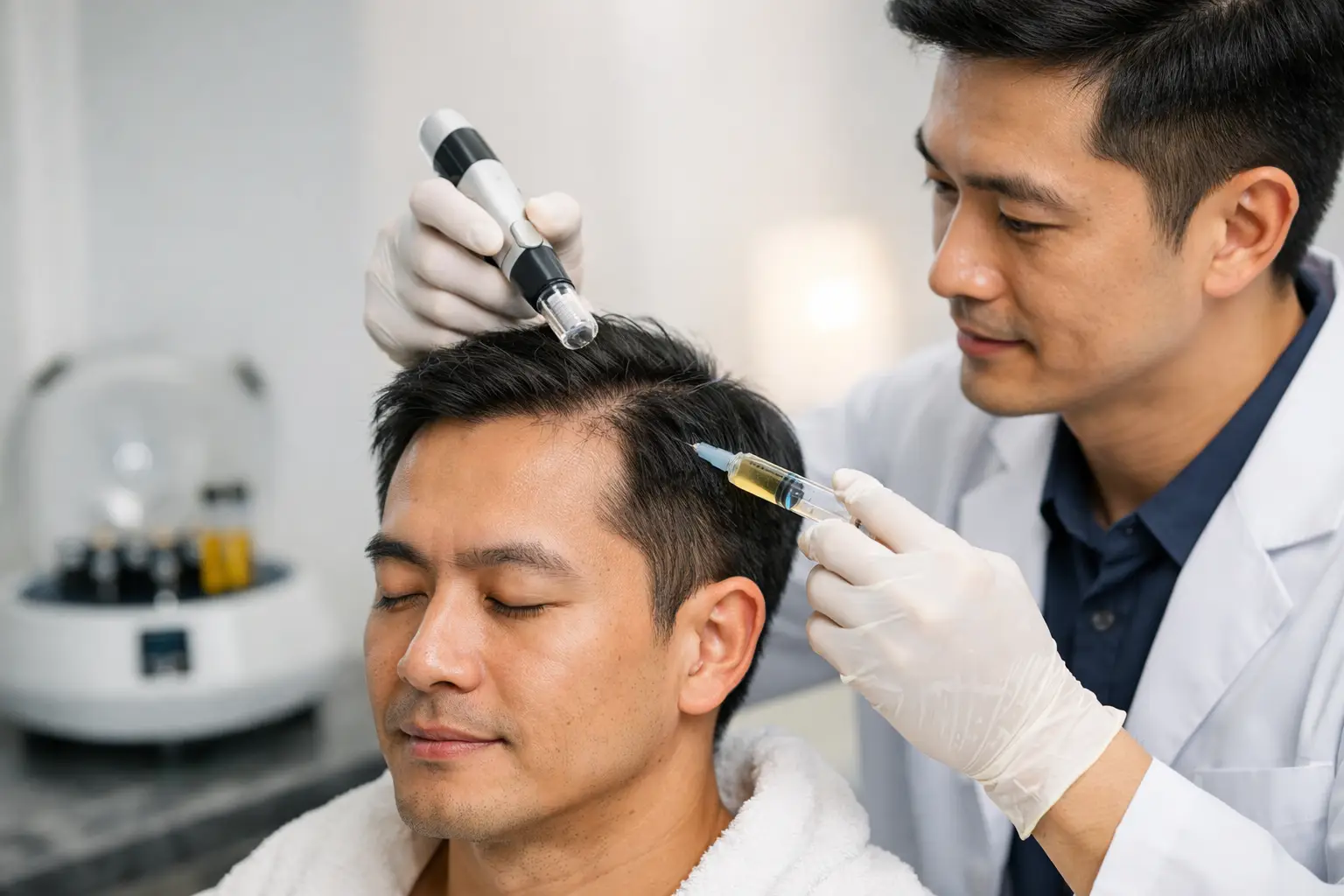
When your hair starts looking thinner under bright office lighting or your scalp shows more than it used to in photos, the concern is rarely just cosmetic. For many men, hair loss affects confidence, how they present themselves at work, and how they feel day to day. That is why micro-needling PRP for scalp rejuvenation has gained attention as a physician-led option for men who want to address early thinning with a treatment that is minimally invasive and grounded in regenerative medicine.
What micro-needling PRP for scalp rejuvenation actually is
This treatment combines two separate methods that are often more effective together than on their own. Microneedling uses very fine needles to create controlled micro-injuries in the scalp. These tiny channels stimulate the skin’s natural repair response and can improve blood flow and signaling around hair follicles.
PRP stands for platelet-rich plasma. A small sample of your blood is taken and processed so the platelet-rich portion can be isolated. That concentrated plasma contains growth factors involved in tissue repair. When applied or injected into the scalp after microneedling, PRP is intended to support a healthier scalp environment and encourage weakened follicles to function better.
The goal is not to create an entirely new hairline overnight. In most cases, the aim is to improve hair density, strengthen miniaturized hairs, and slow the progression of thinning in suitable patients.
Why men consider this treatment
Most men do not seek scalp treatment because they enjoy cosmetic procedures. They usually come in when they notice a clear change – a widening part, more scalp visibility at the crown, excess shedding in the shower, or hair that no longer styles the way it used to. The appeal of microneedling with PRP is that it offers a middle ground between doing nothing and jumping straight to surgical options.
It is also attractive to men who want a discreet, clinic-based treatment with little downtime. You are not committing to major surgery, and you are using your own blood product rather than a synthetic filler. For the right candidate, that can make the treatment feel more practical and easier to accept.
How the treatment works biologically
Hair follicles are influenced by inflammation, blood supply, hormones, genetics, and the condition of the scalp itself. In androgen-related thinning, follicles gradually shrink over time. They may still be alive, but they produce finer, shorter hairs.
Microneedling may help by triggering wound-healing pathways and releasing signals that promote regeneration. PRP may add another layer of support by delivering concentrated growth factors to the target area. The theory is that this combination can improve follicle activity, extend the growth phase of the hair cycle, and support thicker hair production in areas where follicles are weakened but not permanently inactive.
This matters because the treatment tends to work best before hair loss becomes advanced. If a follicle is completely dormant or replaced by scar tissue, stimulation is less likely to produce meaningful regrowth.
Who is a good candidate
Men with early to moderate thinning usually see the most benefit from scalp rejuvenation treatments like this. It can be a reasonable option if you have diffuse thinning, mild recession, or crown thinning and want to improve density without surgery.
It may also suit men who are already using medical hair loss treatment and want to enhance their results. In clinical practice, combination plans often make more sense than relying on a single treatment alone.
That said, not every type of hair loss responds the same way. If shedding is caused by active scalp disease, nutritional deficiency, severe stress, uncontrolled medical conditions, or scarring alopecia, the treatment plan may need to change. This is one reason a proper medical assessment matters. Treating the scalp without identifying the reason for hair loss can waste time and money.
What happens during a session
A typical session begins with scalp assessment and photography so progress can be tracked properly. Blood is then drawn and processed to prepare the platelet-rich plasma. The scalp is cleaned, and a numbing method may be used depending on the treatment approach and your comfort level.
Microneedling is performed over the targeted areas to create controlled channels in the skin. PRP is then applied and, in many cases, injected into specific thinning zones for better delivery. The entire visit is usually completed within the same appointment.
Most men describe the procedure as tolerable rather than pleasant. You may feel pressure, stinging, or a rough vibrating sensation. Mild redness and sensitivity afterward are common, but they generally settle within a short period.
When you can expect results
This is where expectations need to stay realistic. Micro-needling PRP for scalp rejuvenation is not a one-time fix. Hair grows slowly, and follicles need time to respond.
Many patients need a series of sessions spaced weeks apart before changes become noticeable. Early improvements may include less shedding and a healthier scalp feel. Visible changes in thickness and density often take a few months. In some cases, the best results are seen after repeated treatments followed by maintenance sessions.
Results also vary based on age, the cause of hair loss, how long thinning has been present, and whether you are using other supportive treatments. Men with recent thinning generally do better than men with long-standing bald areas.
Benefits and limitations
The main advantage of this treatment is that it is minimally invasive and uses your own blood-derived plasma. There is little downtime, and the approach can be tailored to your pattern of hair loss. For men who want to be proactive without surgery, that is a strong point.
Another benefit is that the treatment focuses on scalp quality as well as follicles. A healthier scalp environment can support better hair growth over time.
The limitation is that results are not guaranteed, and they are rarely dramatic in advanced hair loss. This treatment is better at improving and preserving hair than replacing large areas of loss. If expectations are unrealistic, even a technically successful treatment may feel disappointing.
Risks, side effects, and safety
Because PRP is prepared from your own blood, the risk of allergic reaction is low. Still, this is a medical procedure and should be handled that way. Common short-term effects include redness, scalp tenderness, pinpoint bleeding, swelling, and mild soreness.
Less commonly, patients may experience bruising, temporary increased shedding, or irritation if post-treatment care is not followed properly. Infection is uncommon but possible if proper sterile technique is not used.
You should also tell your doctor about blood disorders, scalp infections, medications that affect clotting, autoimmune conditions, or any history of poor wound healing. These details matter when deciding whether the treatment is appropriate and how to perform it safely.
Why a consultation matters before treatment
A lot of online discussion around hair restoration makes every thinning scalp sound the same. It is not. A receding hairline, crown thinning, sudden diffuse shedding, and patchy loss can point to very different causes.
A proper consultation helps determine whether you are dealing with pattern hair loss, inflammation, hormonal influences, or another medical issue. It also helps set a treatment plan that matches your actual goals. Some men want better density for styling. Others want to slow loss and maintain what they have. Those are related goals, but not identical ones.
At a physician-led clinic such as Catalyst Clinic, that assessment is especially important because the treatment is part of broader men’s health care, not an isolated cosmetic service. If scalp changes overlap with stress, hormone-related issues, or other health concerns, those factors should be considered rather than ignored.
How to get the most from your results
This treatment tends to work best when it is part of a broader plan. Depending on your diagnosis, that may include medical therapy, scalp care, follow-up photography, and scheduled maintenance. Consistency matters more than chasing the newest trend.
Good results also depend on timing. Men who seek treatment early often have more follicles worth saving. Waiting until the scalp is smooth and visibly bare reduces the chance of meaningful improvement.
If you are considering micro-needling PRP for scalp rejuvenation, the most useful first step is not comparing social media before-and-after photos. It is getting a proper diagnosis, understanding what your follicles can realistically do, and choosing a treatment plan that fits your stage of hair loss, your lifestyle, and your expectations. A thoughtful approach usually outperforms a rushed one.